

The short answer
- Use 24 V if you can. At 12 V you start at the bottom of the allowed range, so any cable loss puts you under it.
- Current is about 0.75 A at 24 V, from the 18 W static figure on the spec sheet. Size the supply at 36 W or more per screen.
- At 24 V on 18 AWG, a 100 foot run still delivers about 22.8 V.
- The DC terminal adapter is in the box. An AC adapter is sold separately. There is no PoE.
What the screen draws
Every spec sheet lists 18 W static across all eight sizes. We treat that as a reference figure for the running load, and leave margin for startup.
| Supply | Current at 18 W | Comment |
|---|---|---|
| 12 V DC | 1.50 A | Short leads only. No margin |
| 24 V DC | 0.75 A | Our usual choice |
| 36 V DC | 0.50 A | Top of the range. Do not exceed it |
Sizing a supply. Allow 36 W per screen, about twice the running load. A 24 V unit should be rated at least 1.5 A per screen. Use one listed by a recognized lab, and marked Class 2 where your electrician calls for it.
The accessories page lists a 60 W DIN-rail supply for a cabinet. By this rule, that feeds one screen with headroom. If you want more on one supply, ask your electrician to size it.
How it connects
- Run two conductors from the supply to the screen, with power off.
- Land the leads on the DC terminal adapter from the box: + to +, − to −.
- Turn the supply on and meter at the adapter before you plug in. On a 24 V feed you should read about 23 to 25 V, with polarity as marked.
- Plug the adapter into the DC connector on the unit (the spec sheet lists it as DC2.1). With the player set up, the display starts by itself.
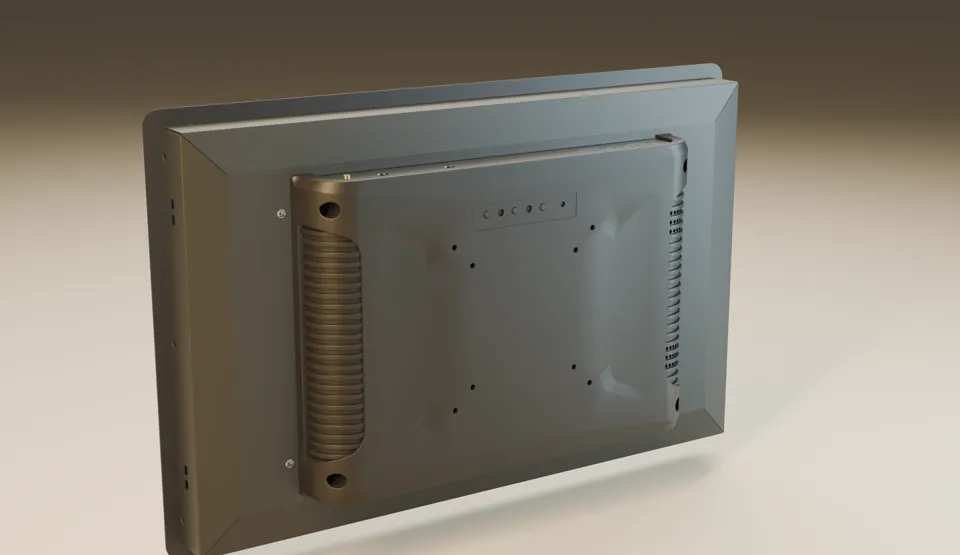
- Relieve the strain on the cable close to the display, and leave a short service loop so the screen can come off its mount.
The spec sheet does not say how the unit handles reversed polarity, so meter first every time. Keep the cable apart from line-voltage wiring. Each unit has a grounding post. Ask your electrician how to treat it on your site.
Voltage drop
Thin wire loses voltage over distance. Here is the voltage left at the display. The figures use 0.75 A at 24 V and 1.5 A at 12 V, a loop of twice the run, and NEC Chapter 9 Table 8 resistance for stranded copper at 75 °C (7.95 ohm per 1000 ft for 18 AWG, 4.99 for 16 AWG, 3.14 for 14 AWG).
| Run, one way | 24 V, 18 AWG | 24 V, 16 AWG | 24 V, 14 AWG | 12 V, 16 AWG | 12 V, 14 AWG |
|---|---|---|---|---|---|
| 10 ft (3 m) | 23.9 V | 23.9 V | 24.0 V | 11.9 V | 11.9 V |
| 25 ft (8 m) | 23.7 V | 23.8 V | 23.9 V | 11.6 V | 11.8 V |
| 50 ft (15 m) | 23.4 V | 23.6 V | 23.8 V | 11.3 V | 11.5 V |
| 100 ft (30 m) | 22.8 V | 23.3 V | 23.5 V | 10.5 V | 11.1 V |
| 200 ft (61 m) | 21.6 V | 22.5 V | 23.1 V | 9.0 V | 10.1 V |
Calculated at the static load. The minimum input is 12 V, so a 12 V supply has nothing to spare at any length.
Look at the two right columns. Every number is under 12 V, because the supply starts at 12 and the wire only takes away. That is the reason to choose 24 V. At 24 V you could lose half your voltage and still be in range. In practice, conductor size on a 24 V run is usually set by your wiring method and not by voltage drop.
A 12 V AC adapter makes sense on a desk or a counter, with its own short lead. Do not extend it.
Who does what
A low-voltage supply does not remove the need for a licensed electrician on the mains side. Local rules decide how the supply is mounted, what class it needs to be, and what cable can go where. In a plenum, a fire-rated wall or an elevator, check with your electrician or inspector first. The elevator guide covers that special case.
Where this is the wrong choice
- You want one cable. There is no PoE. You need a power feed, plus a network cable if you use a wired network at all.
- Above 36 V. A 48 V feed is out of range. Step it down with a suitable converter first.
- Vehicles and battery systems with spikes. The spec sheet lists a 12 to 36 V DC range, with no vehicle or transient rating. Do not read that range as a road-vehicle approval. Feed the unit from a conditioned supply and ask us first.
- A shared rail with noisy loads. Motors and solenoids on the same rail can cause trouble. Use a separate supply for the screens when you can.
Questions
How much power does the display use?
18 W static on the spec sheet for every size: about 1.5 A at 12 V, 0.75 A at 24 V and 0.5 A at 36 V. Allow 36 W per unit when sizing a supply.
Does the display come with a power supply?
A DC terminal adapter is in the box. The AC adapter and DIN-rail supply are sold separately, because many installs run from a low-voltage feed.
Does it support PoE?
No. Power comes from a 12 to 36 V DC supply.
What wire gauge do I need?
At 24 V, voltage drop is rarely the limit: 18 AWG leaves about 22.8 V at the display after a 100 foot run. Your wiring method and local rules usually set the gauge.
Can I use 12 V?
Yes, on a short lead. 12 V is the bottom of the range, so any cable loss leaves you under it. Use 24 V for anything but a short run.
Planning information, not legal or engineering advice. Rules differ by place: check codes and permits with your local authority and your licensed trades.