

The short answer
- Do not tap the car lighting circuit. California's elevator regulator has said in writing that display panels on it do not conform. Budget for a separate circuit.
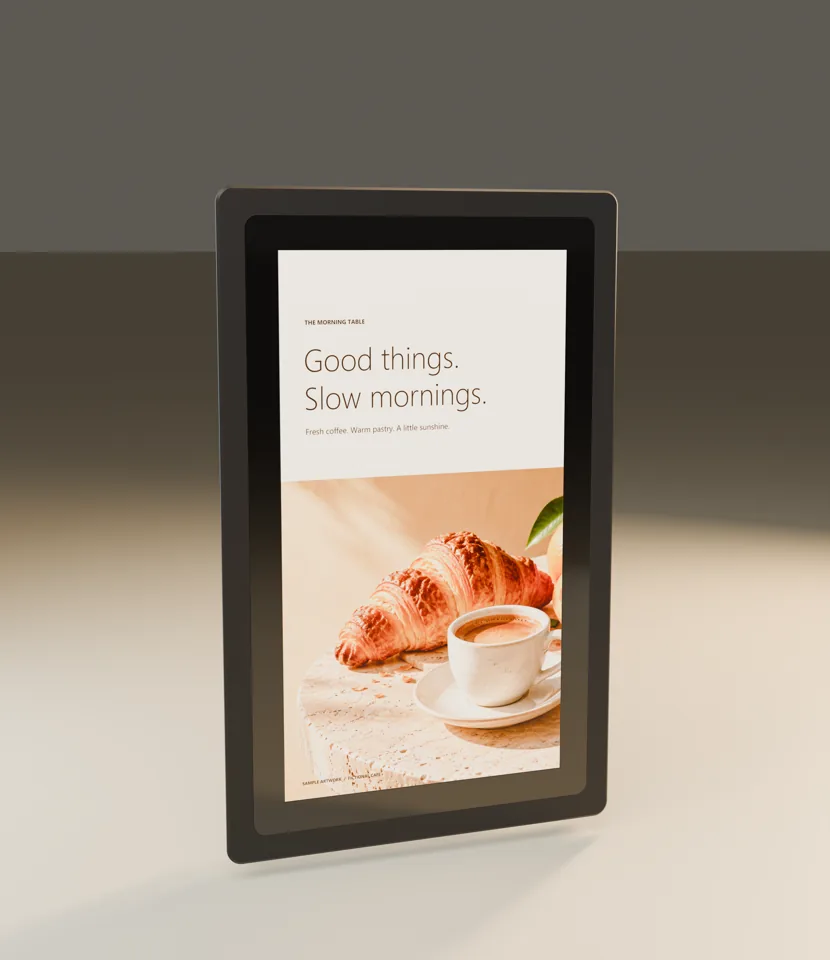
- Of our range, the 15.6 inch in portrait is the usual pick: 269 mm wide, 420 mm tall.
- From 15.6 inches up, our 12 mm wall bracket keeps the unit inside the 4 inch protrusion limit. Smaller sizes are below the listing of that bracket. A flush cut-out is rarely possible, since cab walls are seldom deep enough.
- Content can stay offline: a card in the screen, updated when someone is in the car anyway.
Start with power
You cannot plug a sign into the car's outlet and be done. A memo from California's elevator regulator says use of the car lighting circuit by other devices, and it names display panels, is not in conformance with its Elevator Safety Orders. It points to the separate branch circuit rules in section 620.25 of the state electrical code. Your state may read things differently, so ask, but plan as though yours agrees.
The route we suggest to contractors looks like this. Licensed trades do each step, and your elevator contractor decides what gets used.
- Building panelNew dedicated circuit with its own breaker. Electrician.
- Machine roomJunction where the circuit meets the traveling cable. Electrician to the junction.
- Traveling cableSpare conductors where the cable has them, or a new run. Elevator contractor.
- Car topA listed 24 V DC Class 2 supply, 36 W or more, in an enclosure. Elevator contractor.
- Low-voltage cableTwo conductors, kept apart from line voltage.
- DisplayDC terminal adapter from the box, into the DC connector.
The unit is listed at 18 W static, about 0.75 A at 24 V. The power guide has the voltage drop figures. On a short car-top run they will not worry you.
Do not use the car-top service receptacle or a controller supply. Do not put an AC adapter in the cab.
Mounting and the 4 inch limit
Section 307.2 of the ADA standards limits objects with leading edges more than 27 inches and not more than 80 inches above the floor to 4 inches (100 mm) of protrusion into a circulation path. Our units clear that on a low-profile plate of 12 mm. Whether and how the rule applies inside your car is a question for your contractor and local authority.
| Size | Portrait W x H (mm) | Depth (mm) | With 12 mm bracket | Left of 100 mm | Bracket listed for it |
|---|---|---|---|---|---|
| 10.1 in | 193.6 x 293.6 | 53.5 | 65.5 | 34.5 | Below its listed range |
| 11.6 in | 218.5 x 323.7 | 51.5 | 63.5 | 36.5 | Below its listed range |
| 13.3 in | 245.2 x 373.6 | 57 | 69 | 31 | Below its listed range |
| 15.6 in | 269 x 420 | 70 | 82 | 18 | Yes |
| 17.3 in | 291 x 458 | 67 | 79 | 21 | Yes |
| 18.5 in | 307.4 x 486.5 | 67 | 79 | 21 | Yes |
| 21.5 in | 345 x 557 | 63 | 75 | 25 | Yes |
| 23.8 in | 376 x 606 | 67 | 79 | 21 | Yes |
The bracket is listed for 14 to 24 inch displays. Depth is from each spec sheet.
The drawing for each size shows 75 x 75 and 100 x 100 mm hole patterns, the VESA 75 and 100 layouts. Every drawing marks those holes M4 except the 18.5 inch, which gives no thread size, so we will confirm that one on your order. Fix the plate to the car's structure, not only to a decorative panel. Use tamper-resistant screws where they are exposed.
A flush install looks best, but it rarely works in a car. The cut-out guide lists the clear depth you need, and cab walls seldom have 70 mm to spare.
Where in the car
- Stay clear of the car operating panel, the emergency phone, handrails, and the capacity, data and inspection plates.
- Do not cover lighting or ventilation openings.
- Leave about 2 inches clear beside the edge with the ports, so staff can reach the card slot. If you cannot, plan to use a lift-off plate.
- On a ready-to-play order, tell us which side the port edge will face, and we will set the picture rotation to match.
- Added weight may call for a car balance check. We do not publish a net weight.
- Some jurisdictions limit the finish materials you can add inside a car. Ask before you add trim.
Content with no signal
A steel car in a concrete shaft is about as bad for a network as a building gets. So make the sign independent of one.
The show lives in the screen's internal memory. To change it, someone rides up with a card, puts it in, and waits at least a minute. If the building has Wi-Fi at a landing where the car rests, the player can pull a new playlist from your own HTTPS server when it finds a connection. Any failure is designed to leave the current show on screen. We would not plan on a cellular link in a car.
A person in an elevator looks for a few seconds at most. Keep one message per slide and three short lines. Our content guide has the sizes, and the card tool can show you a slide the way a rider will see it. There is also a page for elevator screens with starter slides to try.
Where this is the wrong choice
- Live news, weather or feeds in the car. The player shows files. A live feed needs a reliable network and a different app, and that network is often the expensive part of the job.
- Selling ad slots. Advertisers usually want proof of play. The player has no such report.
- A contractor who says no. The elevator contractor and your inspector have the final word. If they rule out the wiring, no screen will help you.
- Fire-service or emergency information. A sign is not a safety device. Never use it for required notices or instructions.
Questions
Can I power an elevator screen from the car lighting circuit?
Plan on no. A California elevator regulator memo says display panels on that circuit do not conform, and points to a separate branch circuit. Ask your elevator contractor and local authority what applies to you.
How deep can an elevator screen be?
The ADA standards limit protrusion to 4 inches (100 mm) between 27 and 80 inches above the floor, in circulation paths. Our 15.6 inch unit is 70 mm deep, or 82 mm on our 12 mm bracket.
How do you update an elevator screen with no signal?
With a microSD card or USB stick, once per change. The show is stored in the unit, so nothing depends on the car having a connection. Optional sync can pull updates where the car has Wi-Fi at a landing.
What size screen is usual in an elevator?
We usually start with 15.6 inches in portrait, at 269 by 420 mm. Readers stand close, so a small screen is enough.
Who installs an elevator screen?
A licensed electrician for the building circuit, and your elevator contractor for everything in the hoistway and on the car.
Planning information, not legal or engineering advice. Rules differ by place: check codes and permits with your local authority and your licensed trades.